When it comes to church meetings, there is a subtle yet significant misconception in the Body of Christ that needs to be addressed. Some believers tend to rank certain types of programs, such as crusades, above others, like teaching meetings (referred to here as seminars). However, this perspective is not only myopic but also undermines the holistic purpose of God for the Church. Let’s explore this issue and realign our understanding with Scripture.
Establishing the Foundation
By “seminars,” we mean teaching gatherings, conferences, or classes—essentially meetings dedicated to the systematic exposition of God’s Word. The aim of this discussion is to discourage the needless dichotomy between crusades and seminars. Christ, the Head of the Church, never established such a hierarchy. Both types of meetings serve distinct purposes, yet they work in synergy to fulfill God’s eternal plan for the believer and the global Church.
The Ministry of Jesus: Teaching as a Priority
If we were to examine the earthly ministry of Jesus, teaching emerges as a dominant activity. While He healed the sick, cast out demons, and performed miracles, His teaching ministry laid the foundation for spiritual growth and kingdom advancement. Jesus’ teachings were the framework upon which His followers were built into disciples.
In Matthew 28:19-20, Jesus explicitly commanded His disciples to teach all nations, highlighting the irreplaceable role of teaching in the Church’s mission.
Crusades: Essential for Salvation
Crusades are vital—they are large-scale gatherings focused on preaching the Gospel, leading people to repentance, and facilitating salvation. This cannot be overemphasized. For instance, on the Day of Pentecost, Peter preached a powerful sermon, resulting in 3,000 souls being saved (Acts 2:38-41). This was a monumental moment for the early Church, akin to a modern-day crusade.
However, salvation is just the beginning of the Christian journey. A seed planted must be watered to produce fruit. Without ongoing nourishment, new converts risk spiritual stagnation and, worse, misrepresentation of their faith.
Seminars: Essential for Spiritual Growth
Teaching meetings (seminars) are the watering process that nurtures the seed of salvation. Acts 2:42 reveals that after the Pentecost crusade, the early believers “continued steadfastly in the apostles’ doctrine and fellowship, and in breaking of bread, and in prayers.” Teaching was pivotal in grounding these new converts in the faith.
Paul’s ministry underscores this principle. In Acts 19, Paul preached to twelve disciples and led them to Christ. But he didn’t stop there; he taught in the synagogue for three months and continued daily teachings in the school of Tyrannus for two years (Acts 19:8-10). This intense teaching effort ensured the entire region of Asia was saturated with the Word (Acts 19:20).
Teaching meetings equip believers to:
- Understand their identity in Christ.
- Grow spiritually.
- Serve as effective members of the Body of Christ.
Without teaching, the Church risks raising spiritually immature believers who cannot fulfill God’s purpose on earth.
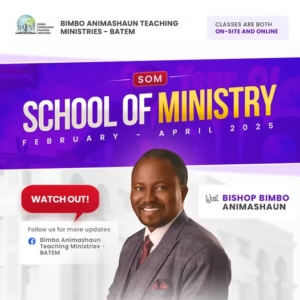
In line with this need for synergy, the importance of structured platforms like the School of Ministry becomes evident. School of Ministry serve as vital hubs for nurturing believers, equipping them with sound doctrine, and preparing them for ministry.
The Synergy of Crusades and Seminars
Both crusades and seminars are indispensable components of God’s plan. Crusades focus on gathering the lost; seminars focus on grounding the saved. Together, they form a seamless cycle of evangelism and discipleship. As Paul wrote in 1 Corinthians 3:6, “I have planted, Apollos watered; but God gave the increase.”
The Body of Christ must recognize that:
- Crusades are not superior to seminars, and seminars are not inferior to crusades.
- Each type of meeting addresses a specific need within the Church.
- Resources should be allocated to both evangelistic and teaching initiatives without bias.
A Call to Ministers
As ministers, we must avoid the pitfall of promoting one type of ministry as more important than another. God has given each minister a specific assignment within His overall agenda. Apostles govern, prophets guide, evangelists gather, pastors guard, and teachers ground. Each role is crucial, and each program—whether a crusade, seminar, or another type of meeting—fulfills a divine purpose.
Ephesians 4:11-13 emphasizes the collective goal: “To equip his people for works of service, so that the body of Christ may be built up until we all reach unity in the faith and in the knowledge of the Son of God and become mature, attaining to the whole measure of the fullness of Christ.”
Conclusion
The Kingdom of God is like a jigsaw puzzle with many pieces. Crusades, seminars, mentorship meetings, healing meetings, prophetic gatherings, and other ministry expressions are all vital components of the greater picture. Instead of comparing or competing, let us embrace the diversity of God’s work and commit to fulfilling our unique roles in His grand plan.
Whether you are planting or watering, remember: it is God who gives the increase. Together, we can partner with the Holy Spirit to establish His Kingdom on earth, without division or dissension. Let’s celebrate the synergy of our collective labor for His glory.